Showing posts with label ACS. Show all posts

Tuesday, April 9, 2013

Prof Isaiah M. Warner awarded with ACS Award in Analytical Chemistry

Prof Warner (source)
American Chemical Society (ACS) spring national meeting at  New Orleans has announced different prestigious awards Chemists from different background.

Among them, ACS Award in Analytical Chemistry is given to Prof Warner from Louisiana State University, for his significant contributions in three distinct areas of analytical chemistry: molecular spectroscopy, separation science, and development and applications of novel nanomaterials.

According to his research group website, his group research involves fundamental studies in analytical chemistry including development of new methods for analytical meausrements. Most of his research are in the general area of bioanalytical chemistry and few on environmental analysis. He is currently Vice Chancellor of Office of Strategic Initiatives and Boyd Professor and Philip W. West Professor of Analytical and Environmental Chemistry at Louisiana State University, Baton Rouge, Louisiana. He has published more than 300 peer reviewed scientific papers and is a reciepient of several prestigious awards recognizing his contribution in analytical chemistry.

A complete list of ACS national awards 2013 can be found here.
 

Thursday, July 19, 2012

Selecting Reviewers for your manuscript:Publishing Your Research 101

In this video, ACS editors will provide some tips to help you decide whom to suggest as reviewers for your article. The reviewers will not only make recommendations on whether or not the work should be published, but on its suitability for the journal. They will also make comments and suggestions to help you improve the quality and clarity of your manuscript, and perhaps even to improve your science. Your article, when published, will be better for having gone through this process. It is to your advantage to have knowledgeable and rigorous reviewers evaluating your manuscript.


Tuesday, June 26, 2012

Writing Your Cover Letter: Publishing Your Research 101

Why cover letter while submitting your manuscript for publication is important and how to write it? 
A video from ACS media.


More info on cover letter writing: Art of the Cover Letter.

Saturday, February 11, 2012

Ethical Considerations for Authors and Reviewers

Important thing to consider while writing a manuscript. Prepared by ACS under publishing your research 101.


From ACS:
Ethical behavior in research and publication form the foundation of scientific discovery and communication. Simply put, experiments should be performed and communicated honestly and with integrity, and attribution should be given to acknowledge the contributions of others.Our editors examine some specific ways in which these principles apply during the publication and peer review process and highlight some of the common problems that arise from both authors and reviewers. 

For reviewers.


Friday, February 18, 2011

A Day Without Chemistry: NOT POSSIBLE

Imagine a day without cars, electric lights, TV, telephones, safe food, and water, medicine, clothing, your house, and thousands of other familiar objects that make up modern society. Do it, and you are imagining a day in a world without chemistry.

What would the world be like without chemistry? 


A short animation created by the American Chemical Society (ACS) shares one humorous take on all that we owe to chemistry. The animation was created to celebrate 2011, the International Year of Chemistry (IYC).  A Day Without Chemistry follows a young man as he sees more and more of his everyday necessities and conveniences disappear before his eyes.


Watch this video. 2011 is the year of Chemistry!! It is being celebrated worldwide.

Thursday, April 8, 2010

239th ACS National Meeting: Pictures from San Fransisco


Last month, I had an opportunity to attend the 239th National Meeting of the American Chemical Society (ACS). It was held in very beautiful city, San Francisco, California from 21st to 25th of March, 2010. It was my second time in the ACS National Meeting. I found that the meeting was quite different than the meeting that I had attended last year in Salt Lake City. Organizer said that this meeting was the biggest ACS meeting according to the number of attendees. This year about 18,000 chemists, scientists and exhibitors were present for about a week in San Francisco. The Moscone Center, where the meeting was held, and the surrounding area up to 3-4 blocks we could see the crowed of people hanging the badges on their neck. Unlike last time, I could not get the opportunity to meet any other Nepalese chemists (except from Reno) even though there were some names listed in the catalog. 

I want to share some photos from the national meeting.


View of San Fransisco (National meeting venue)


Setting up friend's poster

Participants of the meeting

Fellow Nepalese Chemists

Thank you for checking my post.
Lekh N Adhikari
Graduate Student, University of Reno, Nevada

Wednesday, February 10, 2010

40 Young Scholar Awards for Chemists working in developing countries

Award includes:

  • $2500
  • complimentary Congress registration
  • complimentary hotel stay for 5 nights of the meeting
  • a Young Scholar certificate
If you are
  • chemistry professional
  • working in developing countries that border the Pacific Ocean (e.g. from south Asia: Nepal, Bangladesh, Bhutan, Maldives, Sri Lanka)
  • under 40 years
  • in first permanent position in an educational institution, government agency, or other non profit organization as a professional chemist or related science discipline
then you are close to get young scholar award by American Chemical Society.
For this you have to first submit abstract to Pacifichem 2010 conference and a separate application for the award and then finally have to attend the conference going to be held at Hawai on December 2010.

The closing date for receipt of applications is 1 April 2010.
Details of this announcement can be found at Pacifichem 2010.

Thursday, October 22, 2009

"Chemistry—It’s Elemental!" Celebrate National Chemistry Week


American Chemical Society (ACS) is one of the largest professional organizations in the world. Along with other works, ACS celebrates "National Chemistry Week (NCW)" every year in October. This year's NCW is being celebrated from 18–24 October with a slogan  of “Chemistry—It’s Elemental!". According to ACS, National Chemistry Week (NCW) is a community-based annual event that unites ACS local sections, businesses, schools, and individuals in communicating the importance of chemistry to our quality of life. Last year's theme was "The many faces of Chemistry". 


Celebrating such national week about chemistry will help to attract young generation involved in science and popularize chemistry in the society.

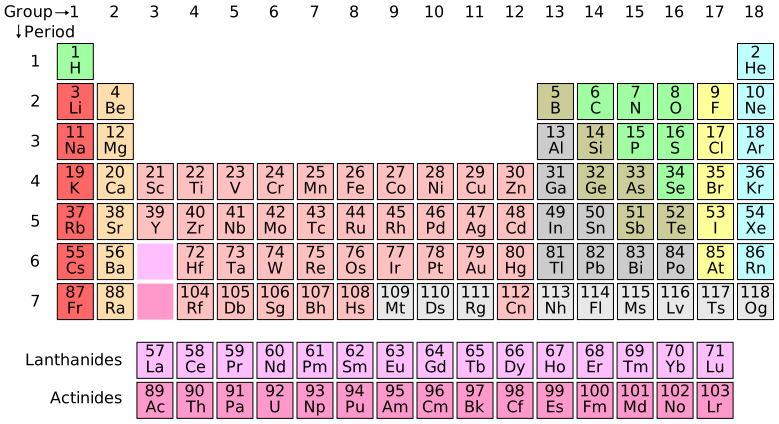
Elements are the important and essential building blocks of matter. In total, 117 elements have been observed as of 2008, of which 94 occur naturally on Earth. One has to start from elements to learn chemistry.


I was going through some websites about NCW and found one very interesting was TierneyLab. They have come up with a quiz for this year's NCW. Here is the question for the quiz.

Your task in the quiz is to match the chemical element to the product in which it is found. Here are the nine elements to consider:
1. Aluminum (Al)
2. Copper (Cu)
3. Magnesium (Mg)
4. Potassium (K)
5. Rhenium (Re)
6. Scandium (Sc)
7. Selenium (Se)
8. Titanium (Ti)
9. Zinc (Zn)
And here are the objects in which these elements can be found:
A. Bananas
B. Electrical wires
C. Green plants
D. Hip implants
E. Jet turbine blades
F. Lightweight bicycle parts
G. Nickels
H. Pennies
I. Photocopiers


To win prize please visit this site and submit your answer.

Happy National Chemistry Week 2009!!

Sunday, August 30, 2009

ACS meeting: An experience

Mahesh Paudyal, University of Missouri-St. Louis

I was excited to participate in national meeting of American Chemical Society (ACS). There were three reasons of my excitement: first, I was going to the nation’s capital for the first time, second, it was my first participation in national level meeting and, third, I was delivering my first oral presentation, here in the United States. I was becoming one of the eyewitnesses of society’s 238th national meeting from August 16-20 at Washington, D. C.


I found Washington, D. C. very hot and humid when we landed there. I do not hesitate to say that we could not figure out the way to the Hotel from web like map of subway train (and we did not bother to ask anybody) which forced us to take the easiest way, taxi (We were aware that boss has still got the NIH fund). We looked each other’s face when we figured out that it (the Hotel) was actually very near from airport and there was a train station just across the street.


From left (up): Lekh N Sharma Gautam, Basu Dev Panthi, Ravi Adhikari, Krishna Panthi, Mahesh Paudyal

I felt like the wave of chemistry is wading me to the shore of sea (full of chemicals) when I went to the Walter E. Convention Center of Wash. D. C., the meeting place and saw huge crowd of chemists (14,234 attendees, C&EN, August 24, 2009). Registration followed by attending the selective sessions of oral presentation (from “BIG” guys of Chemistry) and poster sessions was really helpful, academically. 

“Your English is good but you still have got very thick accent.” This was the first comment that I got from my adviser when I was presenting my talk in front of him few days before leaving to D. C. This, of course, brought lines of disappointment on my face but I did not defend as I knew that it was true. In spite of my nervousness and rush (my greatest demerit), I talked quite well (my own judgment, because I know myself). So I was happy for my first oral presentation in national meeting in front of a medium sized crowd.


I also met some Nepali students. We (Raj K Malla and I) were together in the journey which later was accompanied by my dear dai (Basu Dev Panthi, Baylor University) and Lekh Nath Sharma Gautam (from West Virginia University). We met Mr. Kirshna Panthi and Ravi Adhikari (from Ohio) and Jib R Acharya (from Louisiana).


We took this opportunity to visit nation’s capital. The White House (very simple white colored house, from outside), National space and air museum were among the few but important places that we visited. Vending and mobile shops, beggars at every corner of the street, some narrow and untidy roads and very unclean fast food restaurants were forcing me to ask one question (with obvious answer), Is this the world’s most powerful country’s capital? 

Some facts and figures about this meeting: the largest ever meeting at a Washington, D. C., national meeting, 14,234 attendees (8,531 regular registrants, 3,152 students, 1,438 exhibitors, 458 guests and so). There were 453 booths, 307 exhibitors, and six work-shops at the exposition. (C&EN, August 24, 2009).


From left (down): Mahesh Paudyal, Basu Dev Panthi, Raj K Malla, Lekh N Sharma Gautam


Friday, November 21, 2008

Molecule of the Week: Phosgene

Formula: COCl2
Phosgene, or carbonyl chloride, is an extremely toxic gas, and it was used for that purpose during World War I. Its name is confusing because the molecule does not contain phosphorus. The manufacture of phosgene from chlorine and carbon monoxide was first patented in 1917. Phosgene has been used in many organic syntheses, notably of isocyanates; but its commercial use has been largely discontinued because of its toxicity.

More about Phosgene on wikipedia

More about Molecule of the Week of ACS (American Chemical Sociaty)

Thursday, August 21, 2008

History of Analytical Chemistry-Special issue on AC

Nobody wants another world war. Special issue of Analytical Chemistry, a reputed journal published by American Chemical Society discusses about how second world war helped for the development of analytical chemistry or rise of instruments during world war II. This issue views historical development of analytical chemistry. Along with this, focuses has been made on history of Mass Spectrometry and time line of spectroscopy.

Also you can listen audio interview about the history of Analytical Chemistry.

Just click the link if you are interested.


http://pubs.acs.org/journals/ancham/special_issue/80/15/index.html

Popular Posts