We have one more Chemistry Doctorate in our community. Dr. Achyut Adhikari completed his PhD Degree form University of Karachi Pakistan in November 2009.
The title of his dissertation is “BIOPROSPECTING STUDIES ON SARCOCOCCA CORIACEA (HOOK. F.) OF NEPALESE ORIGIN”.
The summary of his dissertation is follows:
Although fluorine is the most abundant halogen in the Earth’s crust, fluorine containing natural products are extremely rare in nature. This is due to the special properties of fluorine such as: a) it is found in highly insoluble form, therefore it has less bioavailability, b) it has very high heat of hydration due to which it is a poor nucleophile in aqueous solution, and also c) redox potential which is required for the oxidation of fluoride is higher than that generated by the reduction of hydrogen peroxide, thus fluorine cannot be incorporated into organic compounds via the haloperoxidase reaction. Due to these reasons, the mechanism by which C-F bond formation can take place has attracted a considerable scientific interest. Only 18 organofluorine containing natural products have been reported so far. All of them are primary metabolites and no fluorine containing secondary metabolite has been reported from any natural source. This Ph. D. study has led to an exciting discovery of a novel class of fluoropyrimidine substituted alkaloids from a medicinal plant, Sarcococca coriacea of Nepalese origin.
Seven fluoropyrimidine containing steroidal alkaloids and one novel fluoropyrimidine substituted iononehave been obtained. This is the first time that fluorine containing secondary metabolites have been reported from any natural source, which has opened up a new avenue for further research in the chemistry of fluorine- containing secondary metabolites.
Additionally, nine known pregnane-type steroidal alkaloidshave also been isolated for the first time from S. coriacea, which include alkaloid-C, Na-ethylepipachysamine D, sarcovagenine C, sarcovagine D, N-methylpachysamine A , dictyophlebine, 5,6-dihydrosarconidine, terminaline, and iso-N-formylchonemorphine.
Congratulations to Dr. Adhikari on your great achievement and we all wish all the best for your bright future!!!!!!!!
image source: To view in bigger size and clear look click on the image.
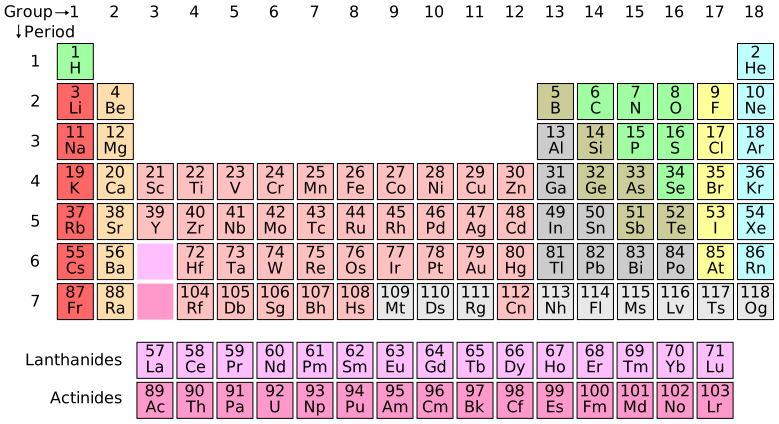
I found this periodic table very useful. This is regular periodic table with picture with each element. Picture is closely related to the element. This gives an impression of the element so that it is easy to know the element. For example: Sun and stars have plenty of hydrogen gas, Lithium is used in battery, Sodium is in our kitchen salt and so on. This periodic table also tells you whether the element is solid, liquid or gas by symbol, which is so cool.
In my high school we had remember the name and symbol of at least 20 elements with atomic number. Memorizing things without any clue is senseless, i guess. But we did it. This new periodic table will improve learning chemistry for beginners.
Periodic table gives info about chemical elements. Like everyone has to start reading and writing with alphabets of the language, periodic table is the alphabet of chemistry.
Myosin is a kind molecular motor. It exists as a dimer with two myosin monomers twisted around each other. It is an interesting molecule because it takes the energy from ATP hydrolysis in an Ca dependent manner and helps to slide the actin molecule. This amazing molecular mechanism is responsible for muscle contraction. The structure of the molecule in the image shows the ATP binding site and different domains of myosin molecule as well as myosin head which binds to the Actin filament. Watch a video about myosin below.
American Chemical Society (ACS) is one of the largest professional organizations in the world. Along with other works, ACS celebrates "National Chemistry Week (NCW)" every year in October. This year's NCW is being celebrated from 18–24 October with a slogan of “Chemistry—It’s Elemental!". According to ACS, National Chemistry Week (NCW) is a community-based annual event that unites ACS local sections, businesses, schools, and individuals in communicating the importance of chemistry to our quality of life. Last year's theme was "The many faces of Chemistry".
Celebrating such national week about chemistry will help to attract young generation involved in science and popularize chemistry in the society.
Elements are the important and essential building blocks of matter. In total, 117 elements have been observed as of 2008, of which 94 occur naturally on Earth. One has to start from elements to learn chemistry.
I was going through some websites about NCW and found one very interesting was TierneyLab. They have come up with a quiz for this year's NCW. Here is the question for the quiz.
Your task in the quiz is to match the chemical element to the product in which it is found. Here are the nine elements to consider:
And here are the objects in which these elements can be found: A. Bananas B. Electrical wires C. Green plants D. Hip implants E. Jet turbine blades F. Lightweight bicycle parts G. Nickels H. Pennies I. Photocopiers
To win prize please visit this site and submit your answer.
Indian born Scientist shares Nobel in Chemistry with 2 other Scientists.
Nobel prize in chemistry for this year of 2009 has been awarded to Venkatraman Ramakrishnan (MRC Laboratory of Molecular Biology Cambridge, United Kingdom-born in India), Thomas A. Steitz (Yale University New Haven, CT, USA; Howard Hughes Medical Institute) and Ada E. Yonath (Weizmann Institute of Science Rehovot, Israel)"for studies of the structure and function of the ribosome". Royal Swedish Academy of Sciences in Stockholm announced in a press conference web-casted live. Three scientists will share the prize equally.
This is the 101st Nobel prize in chemistry since it was started in 1901. It was Alfred Nobel's wish to award to “the person who shall have made the most important chemical discovery or improvement”.
Science is changed a lot since Nobel prize started. Chemistry back in 1900 is different from chemistry now. So the question has raised whether Nobel Prize in chemistry is still relevant to this time? There are some arguments about Nobel given to chemistry. There is an in-depth analysis about this issue in Analytical Chemistry. If you are interested, here is the link. http://pubs.acs.org/doi/full/10.1021/ac9018457
P.S.: Linus Pauling, a Oregon State University graduate, had received Nobel prize two times. One for chemistry and next for peace. Proud to be at OSU.
Time has again come to announce the most prestigious awards in the world-the Nobel Prize. October is the month to announce most anticipated prizes. Two (Nobel for medicine and physics) prizes have been already given for this year of 2009. Nobel in physics has been awarded for groundbreaking achievements concerning the transmission of light in fibers for optical communication (to Charles K. Kao-1/2 of the money) and for the invention of an imaging semiconductor circuit – the CCD sensor (Willard S. Boyle and George E. Smith-each will receive 1/4th of the money). Whereas Nobel for Medicine or physiology went for the discovery of how chromosomes are protected by telomeres and the enzyme telomerase to Elizabeth H. Blackburn, Carol W. Greider and Jack W. Szostak. It is interesting to note that the discoveries made both in physics and medicine were couple of decades back.
Nobel prize in chemistry will be announced tomorrow-Wednesday, October 7, 2009) at 11.45AM CET, 9.45AM GMT, 2.45AM PST (west coast of the USA) and 3.30PM Nepal time during a press conference at the Royal Swedish Academy of Sciences in Stockholm. The announcement is web cast live at Nobelprize.org
The Nobel Prize in Chemistry had been awarded 100 times to 154 Nobel Laureates between 1901 and 2008. A total of 153 individuals have received the Nobel Prize in Chemistry. You can see the list of chemistry Nobel laureates here.